
The Advanced Course
The advanced course for CSHPs® ready to move the conversation from selling a home to planning a next chapter.
See Enrollment OptionsThe Gap
You are more than competent when clients are ready to get started. You understand the housing options. You know the best practices for downsizing and relocating, and you can sell homes in your sleep.
But the truth is, you’ve also sat in a living room where the overwhelm felt heavy. You know you presented all the right solutions, but the conversation ended warmly — nothing decided and nothing signed.
That wasn't a failure of your service offering or your value proposition. It was an indication of a deeper issue. An issue a good coach knows to look for.

You can be the one who waits for the call saying “I’m ready” or you can be the reason they are ready.
The Ready Client
The I’m Not Ready Yet Client
The Ready Client
You answer the questions they ask
The I’m Not Ready Yet Client
You answer the questions they don’t know to ask
The Ready Client
You handle surface-level objections
The I’m Not Ready Yet Client
You anticipate and deal with deeper issues
The Ready Client
You provide detailed information about next steps
The I’m Not Ready Yet Client
You remove the background noise preventing confident decisions
The Ready Client
You lead, direct, guide, and coordinate
The I’m Not Ready Yet Client
You support, empower, consult, and offer solutions
The Ready Client
You manage the details of the move and home sale
The I’m Not Ready Yet Client
You sort out the reluctance preventing the move and home sale
The Ready Client
You see the adult children as a complication
The I’m Not Ready Yet Client
You engage adult children as part of the process
The Ready Client
Your value shows up the day of the listing appointment
The I’m Not Ready Yet Client
Your value shows up months or years ahead of time
The Ready Client
Any solid agent will do
The I’m Not Ready Yet Client
Your engagement and insight are priceless
“The biggest impact of the course material was learning how to listen with intention and how to ask better questions. Learning to ask questions that lead people to self-discover their own motivations and hesitations has helped me to develop deeper relationships and build credibility.”
Beth B. Logullo, CSHP® — Winter Park, FL
What Coaching Sounds Like
Real estate classes teach you scripts to handle objections. But what if they aren't actually objections? What if it's the decision-making process simply happening outloud?
Respond with a script and you’ll go nowhere. Respond as a coach and the conversation moves everyone forward.
The surface issue
Typical agent response
Downsizing coach response
The surface issue
“We’re not ready yet.”
Typical agent response
Agrees, leaves a card, sets a six-month follow-up
Downsizing coach response
Listens for the deeper issue
The surface issue
“It’s all so overwhelming.”
Typical agent response
Reassures them it’ll be fine
Downsizing coach response
Makes it manageable on the spot.
The surface issue
“I need to wait until my kids can help.”
Typical agent response
Waits for the phone call
Downsizing coach response
Seeks to understand the family dynamics
The surface issue
“I don’t know what to do with all the extra stuff.”
Typical agent response
Provides a list of estate liquidators
Downsizing coach response
Hears the stories and affirms the deeper meaning and legacy
The surface issue
“Making all these decisions scares me.”
Typical agent response
Gives a pep talk and changes the subject to something positive
Downsizing coach response
Stays in it. Acknowledges it. Names the fear out loud.
The surface issue
“I’m not physically able to manage this.”
Typical agent response
Offers up a move manager and moving company
Downsizing coach response
Builds the plan around their capabilities, so they feel empowered
The surface issue
“My kids are pressuring me to move.”
Typical agent response
Empathizes with the kids
Downsizing coach response
Gives control back to its rightful owner

A Word from Our Co-Founder
“For a typical agent, the response is about getting a sale. For a coach, every response is an opportunity to empower. That’s what this course teaches.”
Dr. Nikki Buckelew — Co-Founder, Seniors Real Estate Institute
Curriculum
Downsizing Coach Skills Training is a coaching curriculum, not a real estate class. Most of what you’ll learn here hasn’t appeared in any class you’ve ever taken.
Chances are, you’ve been handling these conversations the best you can, with instinct and good intentions.
This strategy works some of the time — if you're lucky — and when it doesn’t, you have no idea what went wrong or what to do differently.
This course answers almost every question about what likely went wrong.

The difference between consulting, coaching, and selling — and which one is needed and when
Letting go of the outcome, the hardest skill here and the one that truly differentiates you
Why prospective clients may choose to talk to you before they are ready, and why they don't
Building real rapport. The kind that lasts.
Sensory language systems and how to communicate within them
The three levels of listening, and why agents rarely leave Level 1
Communication and processing styles, starting with your own
Key client concerns and strategic questions
Chunking up and chunking down
Forward-and-deepen, plus intuition and curiosity as skills you can learn
Asking the hard questions. The ones that have nothing to do with real estate.
Future pacing and asking for insights. Empowerment and confidence building.
Naming the elephant on the table without damaging the relationship
The deeper issues that stall decisions, and how to recognize and get comfortable with them
The two developmental phase-of-life tasks and when you know they are in play
Addressing the predictable dilemmas of aging
A five-step method for building a story
Using client success stories to show people they aren’t the only ones
Storytelling as a way to educate, equip, and empower
What children's books can teach us about being better coaches
The victim complex: its language, its absolutes, and why you’ll still feel pulled to help
Mental illness and neurodegenerative disease in the context of relocation
Family systems, and what happens when your coaching changes a forty-year family pattern
Referring out or walking away, and doing both well
Knowing when where and if it's time to present retirement living options
Treating belongings as a decision, not a logistics job
Relocation services and how to present them as invaluable and necessary
The anatomy of a coaching conversation
How to make coaching a way of life and not just a technique
How to open a coaching conversation, move it forward, and close it with a clear next step
The ten components of a complete coaching conversation, from pre-consultation questionnaire to follow-up
The five stages of readiness and the conversation each one requires
What your coaching is worth, and how to get paid for it
Format and Commitment
Component
Format
Time
Component
Live course modules
Format
Virtual, taught by Dr. Nikki Buckelew, every other week
Time
Eight sessions × 90 minutes — 12 hours
Component
Between-session work
Format
Reading, worksheets, application in your own business
Time
2–4 hours per week
Component
Practice sessions
Format
Live, virtual
Time
60 minutes each — 2 hours total. Pre-scheduled
Component
Comprehensive assessment
Format
Taken once, after modules complete
Time
30 minutes
Component
Total
Format
As with all things, you get out of it what you put into it.
Time
About 47–79 hours over 16 weeks — 3 to 5 hours in a typical week
Session recordings exist for the session you truly can’t make.
In sessions, with your cohort, and in the private sessions. The discomfort is the mechanism for growth and confidence.
The ones who get the most out of this arrive with someone specific in mind who is stuck and who they truly want to help.
The textbooks for this course are college-level material. Our graduates consistently name the reading as the part that most stretched them. Plan for it rather than around it.
The True Value
We won’t promise an income number. That’s not what we are about here. The honest version is simpler: this changes your conversations, your confidence, and your approach. The rest follows from there.
Conversations with longtime homeowners often end warmly and then — waiting. Coaching changes what happens in the room. You ask the questions. The client does the thinking, arrives at their own conclusion, and moves forward.
You enter the conversation long before it’s a true listing appointment. Other agents are just “agents” — you are the trusted guide, the invaluable resource, the person they wouldn’t think of moving forward without.
What you learn here is coaching, not real estate. You’ll use these skills at work, at home, and everywhere you go. The learning is transferable and lifelong — extending long beyond your real estate career.
Selling homes will help you make a living. Coaching people through tough decisions, life changes, and letting go will change how you measure your career success. Much of what comes out of this course doesn’t show up on a settlement statement.

“I use what I learned in the course a lot during our Downsizing Club meetings. I ask a lot of probing questions to get the members to think and engage in the conversation. By asking probing questions, the members answer by giving each other the support they need as they work on downsizing tasks.”
Regina R. Hill, CSHP®, CSDC® — Columbus, Ohio
What’s Included
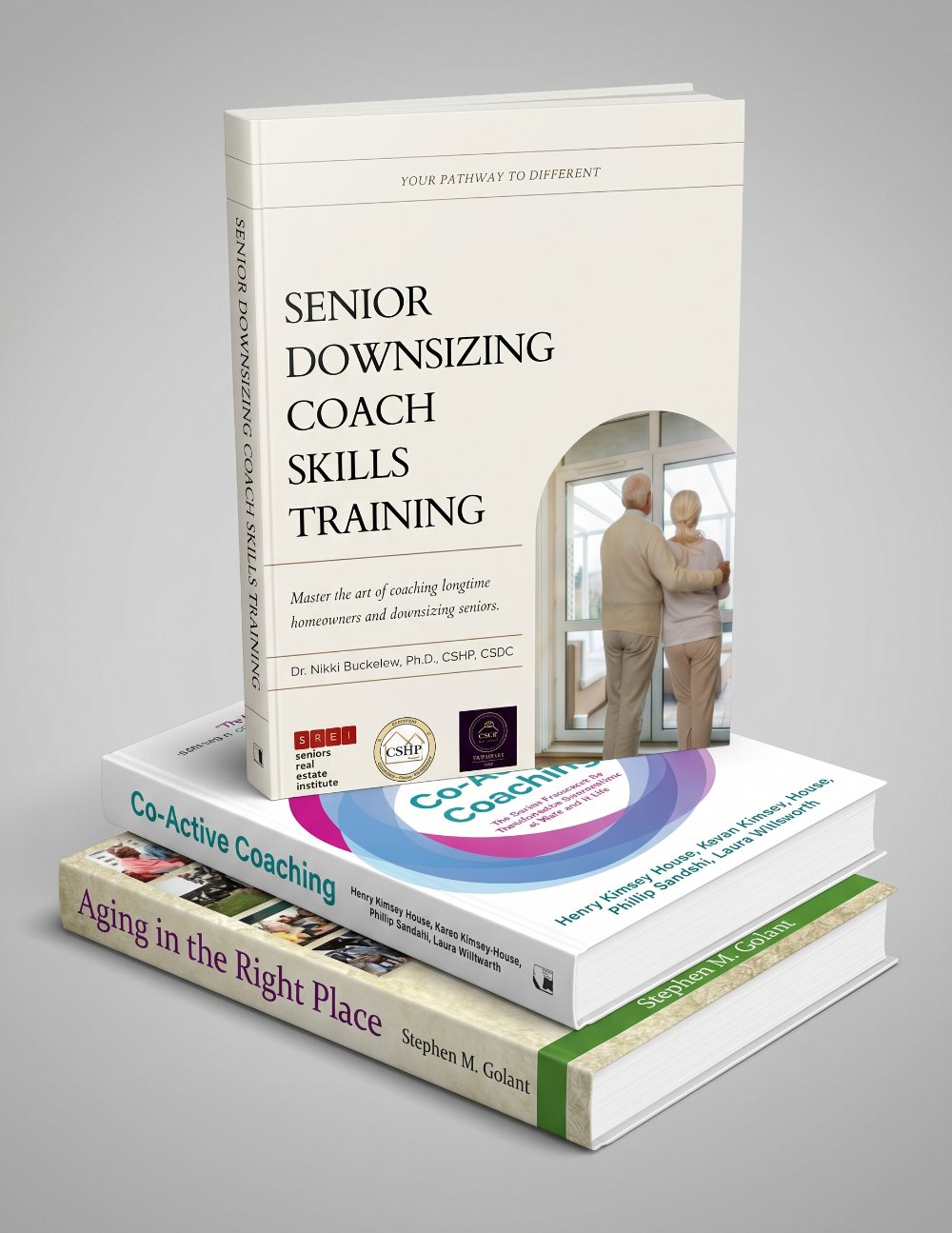
Every module taught personally. Thirty years in this space, a PhD in psychology, a master practitioner of NLP, and a background in counseling and gerontology that informs each lesson.
The working document: forms, scripts, talking points, and the coaching questions that no one gives you in real estate school.
Shipped to your door.
The outside material that informs the framework, curated so you’re not guessing what’s worth your time.
One-on-one. You are the coach. You'll get the truth about your skills and you do it again - only better.
Ongoing access beyond the course via the SREI app. Reach out when you’re stuck. Celebrate your successes. Collaborate with peers.
Walking the Walk
“I thought this was going to be a very easy course and I wouldn’t find it that useful, because I am already a Master’s level social worker. I was pleasantly surprised how much I didn’t know about techniques to use specifically for helping older adults. It taught me how to get them to think and make their own informed decisions. It is their agenda and timing, not mine. I learned way more than I thought I would.”
Rachel Davis, CSHP®, CSDC® — Southern Maine
“I was still building my business from the bottom up after having started on a team four years ago. Not being from this area originally, I decided to invest in becoming a Downsizing Coach because I knew I was only getting busier every year. I knew if I learned one thing that helped me earn just one listing, it would pay for the investment. I’m glad I committed to it and completed the training.”
Karena Stipp, CSHP®, CSDC® — Raleigh, NC

“One of our clients was so fearful to make the move. She said, ‘But what if I don’t love it?’ And I simply responded, ‘But what if you do?’ That one key question I learned in the course started a great conversation about the positives that making the move now, while still in control, could have on her life.”
Kelly Kurtz, CSHP®, CSDC® — Leominster, MA
Next Cohort · Begins January 19, 2027
Fifteen seats. The cohort begins Tuesday, January 19, 2027 and meets every other week through April. Your practice sessions will be scheduled once you are enrolled.
Schedule
January 19
February 2
February 16
March 2
March 16
March 30
April 13
April 27
All Tuesdays, 2:00–3:30 p.m. Central. Two private practice sessions pre-scheduled with you after enrollment. Comprehensive assessment and second practice session come after the last live class.
Tuition
Your seat is held when your first payment is received. Checkout opens in a new tab.
FAQ
Yes, as long as your credential is in good standing. If you’re unsure of your status, contact us and we’ll check.
Then start there. It’s the prerequisite, and it’s not a formality — the coaching work assumes the foundational knowledge.
Not on your own schedule. Recordings exist for a session you genuinely can’t attend, but this is a live, practice-based course.
That depends on what you are looking for. If you’re carrying a list of people who’ve been saying “I’m not ready” for two years, that’s the gap this course closes. If you’re moving people from “I’m not ready” to “let’s do this” with relative ease then you may not need this course.
We provide you with a coaching scenario and composite client profile. You coach to that scenario one-on-one via an online meeting. It’s recorded for you to go back and watch, but you also get specific and honest feedback about your strengths and areas for improvement. Most people find the first one uncomfortable, but helpful, and the second one clarifying and confidence building.
The Success in Seniors Real Estate course that results in CSHP® credentials establishes that you understand the mature market — the housing options, the logistics, the relocation process, and creating a specialty business. This course and the resulting CSDC® establish that you can guide someone through the decision-making process and complexities surrounding it. It gives you the tools to meet people and guide them earlier in the process.
Talk to us. Life happens. We’ll work out a path to completion rather than have you lose the work. Some students have elected to restart the program with the next cohort.
How you choose to use your coaching skills is entirely up to you. Some coaches choose to charge for coaching as a standalone service. Many fold it into how they work and let it do what it does — bring people to a decision, and bring the transaction with it. The course covers both approaches.
It isn’t, and the graduates who come in with clinical training are the ones who say so most plainly. The listening transfers. What doesn’t transfer is applying it to an older adult facing a difficult housing decision — and a transaction attached to the outcome. That’s the part this course teaches that no other course touches.
The skills taught in this course are transferable to many different scenarios — groups included. Graduates use them in Downsizing Club meetings, in seminars, and in consultations, and those in leadership use the skills to train the agents under them. What you’re learning is how a conversation works. That’s a universal skill.